



Ekstra Bladet Page 9, commonly known in Denmark as “Side 9-pigen” or “the Page 9 Girl,” is one of the best-known and most controversial features in Danish tabloid history.
Ekstra Bladet Page 9 traditionally featured a glamour portrait accompanied by a short personal introduction. Although a January 2026 listing featured an adult participant, historical archives also contained photographs of models who were under 18 when photographed. That history has turned the feature into a case study involving consent, gender representation, media ownership, digital permanence, censorship, and archival responsibility.
Over nearly five decades, Page 9 developed from a provocative newspaper feature into a recognizable part of Danish popular culture. Supporters associated it with body confidence, voluntary self-expression, and Denmark’s comparatively relaxed attitude toward glamour photography. Critics argued that it commercialized women’s bodies, reinforced unequal gender roles, and preserved ethically troubling material long after social standards had changed.
The feature’s legacy is therefore more complicated than a simple debate between personal freedom and censorship. It involves questions about individual choice, institutional power, commercial benefit, historical memory, and the rights of people whose images remain in media archives.
Quick Answer
Ekstra Bladet Page 9 is a long-running glamour portrait associated with the Danish tabloid newspaper Ekstra Bladet. It became a regular newspaper feature in 1976 and was traditionally known as Side 9-pigen, meaning “the Page 9 Girl.”
The feature became famous for presenting a model’s photograph with a short introduction containing details such as her name, age, hometown, occupation, or interests. It later faced criticism concerning objectification, narrow beauty standards, historical photographs of underage models, and the commercial use of archive content.
Ekstra Bladet blurred 1,649 digital archive images involving models between 15 and 18 in 2020. In 2022, the newspaper announced plans to destroy photographs of minors in its physical archive, but the material was reportedly preserved under strict access controls after some former models objected to being erased from the historical record.
In 2021, Ekstra Bladet expanded the concept to include men, older participants, and a wider variety of bodies. An archived subscription page from January 2026 indicates that Page 9 content was still available through Ekstra Bladet+, although that single listing does not prove that the feature appeared every day or retained its original print format.
Why Is Ekstra Bladet Page 9 Famous?
Ekstra Bladet Page 9 became famous because it combined glamour photography, tabloid journalism, and Danish cultural attitudes toward personal freedom into a single newspaper feature. For decades, it remained one of the most recognizable parts of the Danish media landscape and generated ongoing debates about body representation, media ethics, censorship, consent, and gender equality.
Today, interest in Ekstra Bladet Page 9 extends beyond the original newspaper feature. Researchers, journalists, artists, and media historians often study it as an example of how cultural values, technology, and public attitudes can change over time.
Key Takeaways
- Ekstra Bladet was launched in 1904 as a publication connected with Politiken.
- The newspaper began experimenting with revealing glamour photography during the 1960s.
- Model and actress Lotte Tarp was central to an early 1964 newspaper experiment.
- The standardized Page 9 feature is widely dated to July 1, 1976.
- The first formal Page 9 participant is commonly identified as 24-year-old Elin Holmtoft.
- The feature is known in Denmark as “Side 9-pigen.”
- It developed during a period of social liberalization and major changes in Danish media culture.
- Supporters describe Page 9 as voluntary self-expression and freedom from body shame.
- Critics view it as commercial objectification and unequal gender representation.
- In 2008, a newspaper redesign removed the feature from its guaranteed position on page nine.
- In 2010, Apple rejected or restricted an Ekstra Bladet application because of the content.
- In 2020, 1,649 online archive images involving models under 18 were blurred.
- In 2021, the concept expanded to include men and more varied participants.
- In 2022, the physical archive became the subject of a destruction-versus-preservation dispute.
- The approximately 20,000-image collection inspired Maja Malou Lyse’s 2024 exhibition Bombshell, Boom!
- Archived evidence indicates that Page 9 remained available as subscription content in January 2026.
Ekstra Bladet Page 9 at a Glance
- Newspaper: Ekstra Bladet
- Country: Denmark
- Original Launch: July 1, 1976
- Danish Name: Side 9-pigen
- Translation: The Page 9 Girl
- Main Debate: Freedom of expression versus objectification
- Archive Controversy: Underage model photographs
- Current Status: Adapted digital and subscription-based presence
What Is Ekstra Bladet Page 9?
Ekstra Bladet Page 9 is a recurring glamour portrait feature connected with Ekstra Bladet’s print and digital publishing history.
For much of its existence, it presented a photograph of a young woman accompanied by a brief personal introduction. The text might identify her name, age, hometown, occupation, education, interests, or ambitions.
In Danish, the best-known name for the feature is:
Side 9-pigen
The phrase translates directly as “the Page 9 Girl.” English-language readers may also encounter variations such as:
- Ekstra Bladet Page 9 Girl
- Ekstra Bladet Side 9
- Side 9 Ekstra Bladet
- Danish Page 9 Girl
- Ekstra Bladet glamour feature
The name originally referred to the feature’s regular location inside the printed newspaper. It eventually became a media brand that survived even when newspaper redesigns changed its placement.
Ekstra Bladet Page 9 is sometimes compared with Britain’s former Page 3 tradition. The concepts have similarities, but the Danish feature developed within a different legal, cultural, and newspaper environment.
Ekstra Bladet Page 9 at a Glance
| Topic | Summary |
| Newspaper | Ekstra Bladet |
| Country | Denmark |
| Danish name | Side 9-pigen |
| Meaning | The Page 9 Girl |
| Formal introduction | Widely dated to July 1, 1976 |
| First formal participant | Commonly identified as Elin Holmtoft, then aged 24 |
| Earlier background | Ekstra Bladet published revealing glamour photography during the 1960s |
| Traditional format | Glamour portrait with a short personal introduction |
| Main cultural debate | personal freedom versus commercial objectification |
| Major ethical controversy | Historical photographs of models under 18 |
| Digital archive action | 1,649 underage images were blurred in 2020 |
| Physical archive dispute | Proposed destruction and later restricted preservation |
| Modern expansion | Men, older adults, and more varied participants included from 2021 |
| Recent evidence | A Page 9 subscription listing was archived in January 2026 |
Ekstra Bladet Page 9 Timeline
| Year | Development |
| 1904 | Ekstra Bladet began as a special publication connected with Politiken during the Russo-Japanese War. |
| 1905 | It develops into a separate afternoon newspaper with news and opinion content. |
| 1964 | Lotte Tarp appears in an early topless-photography experiment associated with editor Victor Andreasen. |
| 1969 | Denmark removes the ban on adult visual material, becoming the first country to make that legal change. |
| 1976 | The standardized Page 9 feature is widely dated to July 1; Elin Holmtoft is commonly identified as its first participant. |
| 2003 | The period during which the newspaper’s minimum participation age had reportedly been 15 comes to an end. |
| 2004 | Page 9 reportedly undergoes a makeover during Ekstra Bladet’s centenary year amid declining readership. |
| 2008 | A newspaper relaunch removes the feature from its guaranteed position on page nine and sometimes presents participants with more clothing. |
| 2010 | Apple objects to Page 9 content in Ekstra Bladet’s proposed iPad application. |
| 2020 | Ekstra Bladet blurs 1,649 digital archive images involving models aged between 15 and 18. |
| 2021 | The newspaper announces that Page 9 may include men, older adults, and more diverse participants. |
| 2022 | The physical archive and the proposed destruction of photographs involving minors become a public controversy. |
| 2024 | Maja Malou Lyse examines the archive, its ownership, and its cultural meaning in Bombshell, Boom! |
| 2026 | An archived January subscription page indicates that Page 9 content remained available through Ekstra Bladet+. |
Why People Still Search for Ekstra Bladet Page 9
People continue searching for Ekstra Bladet Page 9 because it remains one of Denmark’s most recognizable media features. Interest is driven by historical curiosity, archive controversies, media ethics debates, censorship discussions, gender studies research, and questions about whether the feature still exists today.
The topic is frequently referenced in conversations about digital consent, newspaper culture, body representation, and media responsibility.
The History of Ekstra Bladet
Understanding Ekstra Bladet Page 9 requires understanding the newspaper that created it.
Ekstra Bladet was launched in 1904 as an extra publication attached to Politiken. Its original purpose was to provide coverage of the Russo-Japanese War. In 1905, it developed into a separate afternoon newspaper.
The publication became an early Danish example of the boulevard or tabloid press. Its editorial identity was built around:
- Strong headlines
- Large photographs
- Crime reporting
- Political confrontation
- Entertainment and celebrity stories
- Sports coverage
- Stories about ordinary people
- Investigative campaigns
- Deliberate provocation
The newspaper positioned itself as direct, rebellious, anti-authoritarian, and willing to publish material that more restrained newspapers might avoid.
That approach became especially pronounced after Victor Andreasen became editor-in-chief in 1963. Under his leadership, Ekstra Bladet strengthened its reputation as a public challenger of authority and social convention.
During its strongest period in the 1970s and 1980s, the newspaper’s daily circulation exceeded 200,000 copies. Page 9 emerged while Ekstra Bladet had considerable influence over Danish public conversation and popular culture.
The Early Origins of Ekstra Bladet Page 9
The cultural roots of Page 9 appeared before the feature received its permanent name and format.
In 1964, Victor Andreasen reportedly encountered a story about an American woman who had been arrested for appearing topless on a California beach. He used the incident as an opportunity to challenge conservative attitudes toward revealing glamour photography.
A photographer was sent to find a Danish woman willing to appear topless for the newspaper. Model and later actress Lotte Tarp became the first revealing glamour model prominently featured by Ekstra Bladet.
The edition reportedly sold strongly. Its commercial success demonstrated that provocative photography could attract attention while reinforcing Ekstra Bladet’s identity as the rebellious member of the Danish press.
Similar photographs followed. The idea was eventually standardized into the feature known as Side 9-pigen.
When Did Ekstra Bladet Page 9 Officially Begin?
The regular feature is widely dated to July 1, 1976.
Elin Holmtoft, who was 24 at the time, is commonly identified as the first formal Page 9 participant. The introduction represented the beginning of a recognizable and recurring newspaper format rather than Ekstra Bladet’s first use of revealing glamour photography.
The distinction is important:
- Ekstra Bladet experimented with such photography during the 1960s.
- Those early photographs established the editorial and commercial concept.
- The recurring feature known as Page 9 was standardized during the 1970s.
- July 1, 1976, is the most commonly cited formal launch date.
Page 9, therefore, developed gradually from an editorial strategy combining provocation, cultural rebellion, visual spectacle, and newspaper sales.
Why Was It Called Page 9?
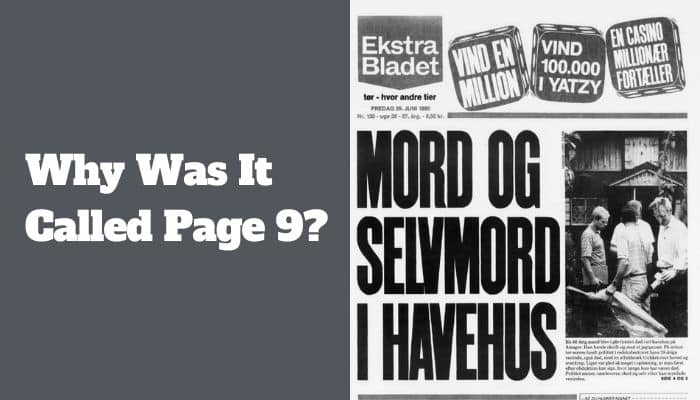
The name Ekstra Bladet Page 9 originally described the physical location of the feature in the printed newspaper.
One widely repeated account states that the photograph was initially intended for page six. That page was considered more commercially valuable for advertising, so the feature was placed on page nine instead.
Its consistent location created several benefits for the newspaper.
1. Reader Habit
Regular buyers knew exactly where to find the feature. Repeating it in the same location helped turn Page 9 into a familiar part of the newspaper-reading routine.
2. Brand Recognition
“Page 9” was simple, memorable, and easy to discuss. The page number gradually became a recognizable brand name rather than only a reference to its position in the newspaper.
3. Newspaper Identity
The section distinguished Ekstra Bladet from competing publications. Its predictable placement supported the newspaper’s provocative and visually driven tabloid identity.
4. Commercial Attention
A feature that readers deliberately sought could support sales, subscriptions, and advertising value. Its popularity also made the surrounding pages commercially important because advertisers could expect regular reader attention.
5. Editorial Continuity
The repeated placement transformed an ordinary newspaper page into a recognizable cultural reference. Even when redesigns later changed the feature’s exact position, readers continued to associate the Page 9 name with the original format.
6. From Page Number to Cultural Symbol
Page 9 eventually became more than a location. It became shorthand for a particular mixture of Danish permissiveness, tabloid provocation, glamour, and controversy.
The name survived because it had accumulated decades of cultural recognition. It could still identify the feature even when it appeared digitally, behind a subscription, or elsewhere in the printed newspaper.
Why the Name Remained Important
Keeping the Page 9 name allowed Ekstra Bladet to preserve continuity with its history. It also helped longtime readers recognize the feature while the newspaper adjusted its format, placement, participants, and digital presentation.
As a result, Page 9 developed into one of the clearest examples of how a simple newspaper location can become a long-lasting media brand.
The Cultural Climate Behind Page 9
Ekstra Bladet Page 9 emerged during major changes in Danish attitudes toward body culture, censorship, personal freedom, and the public representation of the body.
Denmark legalized certain forms of adult-oriented published material in 1967 and removed its prohibition on visual adult material on July 1, 1969. It became the first country to make that broader legal change.
The development of Page 9 also reflected wider social trends:
- Traditional moral authority was weakening.
- Younger generations were challenging established social rules.
- Women’s liberation movements were questioning conventional gender roles.
- Body-focused imagery was increasingly presented as natural or anti-authoritarian.
- Commercial media recognized the attention value of glamour imagery.
- Tabloid newspapers competed aggressively for readers.
- Denmark developed an international reputation for socially liberal attitudes toward the body and personal freedom.
These developments did not all support the same political or cultural position.
For some people, glamour photography represented freedom from shame and conservative control. For others, the commercial use of women’s bodies was not liberation but an updated form of inequality.
That conflict between personal freedom and commercial exploitation became central to the Page 9 debate.
How the Traditional Page 9 Format Worked
The traditional format was visually simple and easy to recognize.
It generally included:
- A professionally produced glamour portrait
- The participant’s first name
- Her age
- Her hometown or local area
- A brief description
- Information about work, education, interests, or ambitions
The biographical text gave the participant an identity beyond the image, but the photograph remained the section’s main attraction.
For some participants, appearing on Ekstra Bladet Page 9 could provide:
- Public exposure
- A professional photography experience
- Entry into modelling or entertainment
- A personal milestone
- Confidence and body-positive expression
- Participation in a familiar Danish tradition
For Ekstra Bladet, the feature provided:
- Reader attention
- A recognizable identity
- Repeat interest
- Newsstand differentiation
- Subscription value
- Opportunities for promotion and merchandise
- A continuing source of controversy and publicity
Page 9: Liberation, Objectification, or Both?
Ekstra Bladet Page 9 has long been interpreted in two contrasting ways. Supporters view it as an expression of adult choice, body confidence, and Denmark’s comparatively relaxed attitude toward glamour photography. Critics argue that it commercialized women’s bodies and reinforced unequal gender representation.
For some adult participants, appearing on Page 9 could represent:
- Personal control over their bodies
- Comfort with body-focused imagery
- Rejection of conservative social expectations
- Confidence and self-expression
- An opportunity to enter modelling or entertainment
- Voluntary participation in a familiar Danish media tradition
Some former participants have described their appearance positively. It would therefore be inaccurate to portray every adult model as powerless, misled, or exploited. Adults may knowingly participate in glamour photography for personal, professional, financial, or expressive reasons.
However, individual consent does not settle the broader institutional debate. Critics argue that Page 9 placed appearance-focused glamour images of women inside a newspaper dominated by stories about politics, business, crime, sport, and public power.
This created a noticeable contrast:
- Men commonly appeared as politicians, executives, athletes, experts, and decision-makers.
- Women on Page 9 were presented primarily through appearance and conventional standards of physical attractiveness.
- The repeated format promoted relatively narrow beauty standards.
- The newspaper controlled publication, promotion, archive access, and long-term commercial use.
- The publisher generally received greater lasting commercial value than an individual participant.
Ekstra Bladet Page 9 can therefore involve personal agency and commercial objectification at the same time. A model may genuinely feel empowered by participating while critics still question the gender expectations and business structure surrounding the feature.
The debate is not simply about whether an adult agreed to pose. It is also about who controlled the platform, how women were repeatedly represented, who benefited commercially, and who carried the long-term privacy or reputational risks.
Rather than describing Page 9 as entirely liberating or entirely exploitative, it is more accurate to recognize the tension between individual choice and institutional power.
Arguments Supporting and Criticizing Page 9
| Arguments supporting the feature | Arguments criticizing the feature |
| Adults should control how they present their bodies | Commercial media can turn people’s bodies into products |
| body exposure or revealing imagery is not automatically harmful or shameful | Women were historically represented differently from powerful men |
| Participation could provide confidence and exposure | The format reinforced limited beauty standards |
| Page 9 reflected Danish cultural openness | The newspaper normalized appearance-focused representation of women. |
| Models could benefit personally or professionally | The publisher controlled the archive and long-term commercial value |
| The feature challenged conservative censorship | Criticism concerns power and context, not glamour photography alone |
| Wider participation can improve representation | Inclusion does not automatically eliminate objectification |
Both perspectives contain legitimate concerns. The cultural meaning of Page 9 depends on how a reader weighs adult choice against institutional power, repeated representation, and commercial control.
Major Controversies Associated With Page 9
Although Page 9 became a cultural institution, it also generated multiple controversies throughout its history.
The most discussed issues include:
- Representation of women in tabloid media
- Commercialization of appearance-focused content
- Historical photographs involving participants under 18
- Archive preservation versus deletion
- Digital consent and online permanence
- Platform restrictions and censorship debates
- Questions about editorial responsibility
The Most Serious Controversy: Models Under 18
The most consequential controversy in the history of Ekstra Bladet Page 9 involves photographs of models who were under 18 when their pictures were taken.
In 2020, public criticism focused on historical images involving participants aged between 15 and 18. The newspaper’s minimum participation age had reportedly been 15 until 2003.
A journalism-industry report stated that 1,649 images involving underage models had remained available through Ekstra Bladet’s online archive. The content was placed behind a subscription paywall.
Criticism intensified after reports that some images had been copied and used without permission on abusive websites. Ekstra Bladet responded by blurring the relevant digital archive photographs rather than deleting the entries completely.
The controversy raised difficult questions:
- Can a teenager meaningfully consent to permanent publication of revealing glamour photographs?
- Should historical legality determine modern ethical decisions?
- Is consent for one print edition equivalent to consent for permanent online access?
- Should a publisher continue monetizing such archive material?
- What responsibility exists when images are copied and misused?
- Should the material be destroyed, restricted, or preserved for historical research?
- Who should make decisions about the future of the photographs?
The issue transformed the Page 9 debate. It was no longer solely about whether adults should be free to pose. It became a discussion about child protection, historical responsibility, digital permanence, and institutional power.
Legal Standards and Ethical Standards Are Different
A historical practice may have been legal or culturally accepted at the time while failing modern ethical standards.
Historical context helps explain how a practice occurred. It does not automatically justify continued publication or commercial access.
A publisher may also own a physical photograph or hold contractual rights without possessing unlimited moral permission to distribute it forever.
A modern ethical assessment should consider:
- The participant’s age when photographed
- The nature of the original consent
- Whether a parent or guardian was involved
- The intended publication medium
- The expected duration of publication
- Online republication
- Search-engine indexing
- Global accessibility
- Subscription monetization
- Unauthorized copying
- The participant’s wishes as an adult
- Legitimate historical or research value
The Ekstra Bladet Page 9 archive demonstrates how an agreement created for temporary print publication can become ethically unstable when transferred to permanent digital storage.
Who Controls the Page 9 Archive?
The Ekstra Bladet Page 9 photographic collection is held within JP/Politiken Media Group, the media organization associated with Ekstra Bladet.
Ekstra Bladet commissioned, created, published, and commercially used the photographs. However, archive control involves more than ownership of physical envelopes or photographic files.
Control includes the ability to decide:
- Who can access the photographs
- Whether they remain online
- Whether they may be republished
- Whether researchers may inspect them
- Whether copies can be made
- Whether the material should be destroyed
- Whether former participants can request restrictions
- How the collection is interpreted publicly
Accounts associated with the Bombshell, Boom! project describe the broader archive as containing approximately 20,000 photographs.
The photographs involving minors were reportedly removed from the ordinary archive and stored in a separate locked space. Access was limited to people depicted in the photographs, their families in relevant circumstances, or individuals with a legitimate research interest.
This arrangement attempts to distinguish historical preservation from public distribution. It does not resolve every ethical concern, but it reduces the risk of unrestricted access and commercial reuse.
What Have Former Page 9 Models Said?
Former Ekstra Bladet Page 9 participants have not expressed one single position about the archive.
Some people may prefer sensitive photographs to be blurred, restricted, or permanently removed. They may no longer identify with a decision made decades earlier or may be concerned about family, employment, digital copying, and personal privacy.
Other former participants reportedly opposed complete destruction of the physical archive. They argued that removing every photograph would erase their experience and eliminate evidence of an important, although controversial, part of Danish media history.
The disagreement shows why former models should not be treated as a single group.
It would be misleading to claim that:
- All participants viewed Page 9 as empowering
- All participants now regret appearing
- All former models support preservation
- All former models want the photographs destroyed
- Every underage participant understood the long-term consequences
- Every former participant considers herself a victim
A responsible archive policy should allow the people represented in the collection to express their own preferences wherever possible.
The Difference Between the 2020 and 2022 Archive Events
The online and physical archive controversies were related but not the same event.
2020: The digital archive
In 2020, attention focused on 1,649 online images involving models aged between 15 and 18. Ekstra Bladet blurred the photographs after criticism concerning their availability, commercial access, and reported unauthorized reuse.
The entries were not simply part of a sealed historical collection. They had been made available through the newspaper’s subscription archive.
2022: The physical archive
In 2022, attention moved to the original physical photographs stored within the media organization.
Ekstra Bladet announced that photographs involving minors would be destroyed. The proposal created a new controversy because some former participants objected to the complete removal of their images from the historical record.
The eventual restricted arrangement
Later accounts indicate that the photographs were not destroyed. Instead, they were moved into secure storage with tightly restricted access.
This outcome attempted to balance:
- Participant privacy
- Protection against misuse
- Historical preservation
- Research access
- Institutional responsibility
- The wishes of former models
The distinction between the two events is essential. The 2020 decision concerned public digital access, while the 2022 dispute concerned physical preservation and destruction.
Should Controversial Archive Images Be Destroyed?
The Page 9 archive presents a genuine ethical dilemma.
Arguments for destruction
- The photographs involve people who were legally children.
- Continued storage creates a risk of misuse or unauthorized access.
- Participants may no longer consent to preservation.
- The original commercial purpose has ended.
- Destruction could prevent future publication or copying.
- The material may cause continuing harm.
Arguments for restricted preservation
- Destruction can erase evidence of past media practices.
- Researchers may need controlled access to study historical exploitation.
- Some former participants want their experiences preserved.
- The archive documents changing attitudes toward bodies, body culture, fashion, and photography.
- Secure preservation does not require public availability.
- Institutions should not erase embarrassing history merely to protect their reputations.
The most defensible distinction may be between preservation and publication.
Material can be preserved under strict controls for legitimate historical purposes without remaining publicly searchable, downloadable, commercially available, or accessible to casual viewers.
The 2010 Apple App Store Dispute
Ekstra Bladet Page 9 encountered a different form of censorship controversy when the newspaper entered mobile publishing.
In 2010, Apple rejected or restricted Ekstra Bladet’s proposed iPad application because the Page 9 content conflicted with its App Store policies.
Then-editor Poul Madsen objected strongly. He argued that Page 9 was part of the newspaper’s identity and an expression of Danish freedom of speech. He accused Apple of censorship and anti-competitive behavior and discussed taking the conflict to European legal authorities.
The dispute highlighted a major shift in media power.
In print, Ekstra Bladet controlled:
- Editorial selection
- Page design
- Distribution
- Reader access
- Advertising placement
- The conditions under which the newspaper was sold
In the app economy, Apple controlled access to a major distribution platform and could impose standards that were stricter than Danish law.
The disagreement, therefore, involved more than one photograph. It raised questions about:
- Platform censorship
- National culture versus international corporate rules
- Private control over media distribution
- Freedom of expression
- Competition
- The difference between legal content and platform-approved content
Why the Apple Conflict Still Matters
The dispute anticipated modern arguments about technology companies acting as media gatekeepers.
News publishers now depend on organizations that operate:
- App stores
- Search engines
- Social networks
- Advertising systems
- Payment processing
- Hosting infrastructure
- Recommendation algorithms
- Content-moderation systems
Each intermediary can establish its own rules concerning body exposure or revealing imagery, mature visual content, monetization, and age restrictions.
Content may therefore be legal in the publisher’s country but still face restrictions because of policies governing visual glamour content.
Ekstra Bladet Page 9 became an early example of a traditional newspaper discovering that digital distribution required negotiation with global technology companies.
Efforts to Modernize Ekstra Bladet Page 9
By the early 21st century, the traditional format faced changing reader expectations, declining print circulation, and increasing criticism of its portrayal of women.
During a 2008 newspaper relaunch, Ekstra Bladet removed the glamour portrait from its guaranteed position on page nine. The newspaper said participants would continue to appear elsewhere and might sometimes be shown wearing more clothing.
Page nine was instead used for a regular column giving prominent women a space to comment on public and cultural subjects.
The change did not permanently eliminate the larger concept. Page 9 remained recognizable as a brand and continued to evolve across print and digital formats.
In November 2021, Ekstra Bladet announced that the portrait would no longer need to feature only a young woman.
The newspaper said it could include:
- Men
- Older women
- Participants with different body types
- People representing greater gender diversity
- A wider cross-section of society
Editor Henrik Qvortrup described the decision as an attempt to democratize the feature and reflect diversity more accurately. He also acknowledged that older versions of Ekstra Bladet had contained too much male-dominated culture.
How Ekstra Bladet Responded to Criticism
Ekstra Bladet’s responses to criticism have changed over time.
2008: Relocation and redesign
The newspaper removed the feature from its guaranteed place on page nine and introduced a daily commentary space involving women.
2010: Defense against platform restrictions
Ekstra Bladet defended Page 9 against Apple, presenting the feature as an expression of Danish publishing freedom.
2020: Digital archive blurring
The newspaper blurred 1,649 historical images involving models under 18 after criticism of their availability and misuse.
2021: Broader representation
Ekstra Bladet expanded the concept to include men, older adults, and more diverse participants.
2022: Physical archive action
The newspaper announced plans to destroy photographs involving minors before resistance from some former participants led to a restricted preservation arrangement.
Continued adaptation
Rather than discontinuing Page 9 completely, Ekstra Bladet repeatedly modified its placement, presentation, participants, archive access, and commercial format.
Readers may interpret these changes in different ways. They can be seen as:
- Genuine ethical reform
- A response to public pressure
- Commercial repositioning
- An effort to protect a recognizable brand
- A combination of all these factors
Did Including Men Solve the Gender Problem?
Including men and more diverse participants challenged the assumption that only young women should be displayed for readers.
However, it did not resolve every criticism.
Supporters could argue that wider participation makes the format more equal and representative. Critics could respond that adding men does not change the underlying commercial use of appearance-focused bodies.
The change creates several questions:
- Is an equal-opportunity commercial display a form of equality?
- Does wider representation transform the meaning of the feature?
- Can a historically gendered brand separate itself from its past?
- Is the main issue who appears, or why bodies are being displayed?
- Can a commercial glamour feature also be genuinely body-positive?
There is no universally accepted answer. The expansion shows that Ekstra Bladet Page 9 has attempted to respond to cultural change without abandoning its identity completely.
How the Internet Changed Page 9 Forever
Before digital publishing, a newspaper photograph usually had a limited lifespan. Once archived online, however, images became searchable, shareable, and permanently accessible.
This transformation changed the ethical questions surrounding Page 9. What was once a temporary newspaper appearance could become part of a permanent digital record visible decades later.
As a result, debates about consent, privacy, and archive management became far more important than they had been during the print era.
Ekstra Bladet Page 9 and the Digital Age
Page 9 was designed for a printed newspaper. Digital publication changed the meaning and potential consequences of participation.
A print photograph once had a relatively limited life:
- It appeared in a particular edition.
- It circulated mainly within Denmark.
- Most copies were eventually discarded.
- Finding an old image required access to a physical newspaper or archive.
A digital photograph can be:
- Indexed by search engines
- Shared internationally
- Downloaded
- Copied without permission
- Reposted outside its original context
- Stored indefinitely
- Connected with a participant’s full identity
- Viewed by employers or family members years later
- Used in automated datasets or image-manipulation systems
This creates a major consent problem.
A person who agreed to appear in one day’s print newspaper decades ago did not necessarily understand or approve permanent global availability.
Digitization, therefore, creates a duty for publishers to reassess historical material instead of assuming that an old consent agreement covers every future distribution method.
Page 9, Commercial Value, and Tabloid Economics
Page 9 survived partly because it was commercially useful.
It attracted attention, differentiated Ekstra Bladet from competitors, encouraged reader familiarity, and became part of the newspaper’s brand.
The participants supplied the visual content, while the publisher controlled:
- The audience
- Page placement
- Promotion
- Advertising
- Subscription access
- Archive storage
- Republication
- Long-term commercial use
This commercial structure complicates claims that the feature existed only to celebrate freedom or body confidence.
Cultural liberalism may have contributed to its popularity, but so did:
- Newspaper sales
- Reader curiosity
- Advertising value
- Subscription revenue
- Brand recognition
- Competitive tabloid strategy
- Public controversy
- Digital engagement
The feature’s longevity cannot be explained through culture alone. It also remained because it attracted and retained attention.
Page 9 and the Wider Gender-Equality Debate
Criticism of Ekstra Bladet Page 9 grew more significant amid broader discussions of gender, workplace behavior, and institutional power in Danish media.
In 2020, Danish and Swedish journalism reporting documented allegations involving workplace harassment and gender-biased culture within Danish news organizations, including Ekstra Bladet. Coverage also noted that the newspaper had already faced recurring criticism concerning its representation of women and continued use of the Page 9 concept.
These issues should not be treated as identical.
The existence of Page 9 does not prove or directly cause unrelated workplace misconduct. However, the feature became part of a broader debate about the messages media organizations communicate about women.
The discussion asked whether a news organization could address concerns about workplace equality while continuing to commercialize a historically glamour-focused portrayal of women.
The relationship is therefore cultural and institutional rather than a claim of direct causation.
Page 9 as a Cultural Institution
Despite continuing criticism, Ekstra Bladet Page 9 became an identifiable part of Danish popular culture.
The phrase “Side 9-pigen” was recognizable even to people who did not regularly buy Ekstra Bladet. It appeared in discussions about:
- Beauty
- Celebrity
- Gender
- Freedom
- Censorship
- Tabloid journalism
- body culture
- National identity
- Media ethics
Some participants later entered modelling, entertainment, television, or public life. For others, the appearance remained a brief personal experience.
The feature’s cultural influence came from repetition. One glamour portrait would have had limited historical importance. A recurring feature maintained for decades became a social symbol.
How Page 9 Shaped the Ekstra Bladet Brand
Page 9 reinforced several elements of Ekstra Bladet’s identity.
Provocation: It showed that the newspaper was willing to challenge conservative expectations.
Accessibility: It supported a popular and informal style rather than the image of an elite political newspaper.
Predictability: Readers knew what kind of feature to expect, creating a familiar ritual.
Sensationalism: It connected serious news coverage with attention-grabbing visual content.
Rebellion: When critics or technology platforms objected, the newspaper could present itself as a defender of Danish openness and freedom.
Commercial recognition: The name became valuable beyond its original location and could be used across subscriptions, promotions, and digital content.
The feature also created reputational costs. Readers who viewed it as gender-biased, outdated, or ethically irresponsible could see it as evidence that the newspaper prioritized provocation over responsible representation.
Comparison With Britain’s Page 3
Ekstra Bladet Page 9 is frequently compared with the Page 3 tradition associated with the British newspaper The Sun.
| Ekstra Bladet Page 9 | British Page 3 |
| Associated with Denmark | Associated with the United Kingdom |
| Known as Side 9-pigen | Known as the Page 3 Girl |
| Standardized in 1976 | Developed as a regular Sun feature during the 1970s |
| Connected with Danish social liberalization | Connected with British tabloid culture and male-oriented popular media |
| Faced an Apple application dispute | Faced sustained political and activist campaigns |
| Expanded to include men and wider representation | The Sun ended its regular topless format in 2015 |
| Continued in an adapted digital or subscription form | Generally treated as a discontinued newspaper institution |
| Became central to a major archive-ethics controversy | The debate focused heavily on everyday objectification and newspaper availability |
Both formats generated arguments about consent, censorship, objectification, press freedom, and the representation of women.
However, they are not identical. Each developed within a different national culture, legal system, newspaper market, and political debate.
Art, Memory, and Bombshell, Boom!
Artist Maja Malou Lyse reconsidered the cultural meaning of Ekstra Bladet Page 9 in her 2024 project Bombshell, Boom!
Lyse researched the extensive Page 9 photo archive held within JP/Politiken Media Group. The exhibition examined the participants not simply as anonymous glamour images but as individuals positioned within a system involving media ownership, commerce, memory, and changing standards.
The project addressed:
- Blurred digital archive images
- Historical censorship
- The identities of former models
- Commercial ownership
- Restricted physical storage
- Who controls cultural memory
- The conflict between preservation and erasure
- How ideals of femininity and beauty changed over time
The project described the archive as containing approximately 20,000 photographs. It also documented resistance from former models who opposed the destruction of material involving underage participants because they believed complete erasure would remove part of their history.
Lyse entered the tradition herself by appearing as the Page 9 participant on the exhibition’s opening day.
This placed the artist inside the institution she was examining rather than allowing her to remain an outside observer.
The exhibition showed that the archive cannot be reduced to a simple choice between celebration and condemnation. It contains evidence of:
- Personal agency
- Commercial exploitation
- Historical harm
- Changing beauty standards
- Evolving photography technology
- Media power
- Cultural memory
- Conflicting participant perspectives
Is Ekstra Bladet Page 9 Still Published in 2026?
Available evidence indicates that Page 9 content remained accessible in early 2026.
An archived Ekstra Bladet page captured on January 4, 2026, introduced a 25-year-old participant named Michella and placed the full content behind an Ekstra Bladet+ subscription prompt.
This supports the limited conclusion that Page 9-branded content was still available at that time.
However, an archived subscription page does not by itself prove that:
- The feature appeared every day
- It remained on the ninth page of the print edition
- Every newspaper edition included it
- Its presentation was identical to the historical format
- The same editorial rules applied throughout 2026
- It continued unchanged after the archive date
The most accurate description is therefore:
Archived evidence confirms that an Ekstra Bladet Page 9 listing was accessible through the newspaper’s subscription service in early January 2026, but the evidence does not establish its publication frequency or exact print placement.
This distinction prevents a single archived page from being used to make an unsupported broader claim.
Why Has Ekstra Bladet Page 9 Survived for So Long?
Several factors help explain its longevity.
- Strong brand recognition: The name became embedded in Danish popular culture.
- Reader familiarity: Long-running newspaper features can become habits, even among readers who criticize them.
- Commercial usefulness: Provocative content attracts attention and discussion.
- Adaptability: The concept moved between fixed print placement, alternative pages, mobile formats, digital archives, subscription content, and more varied representations.
- Controversy: Criticism repeatedly returned Page 9 to public discussion, increasing awareness of the brand.
- Cultural ambiguity: The feature can be interpreted as body freedom, personal expression, commercial glamour, outdated gender bias, or institutional exploitation.
- Historical identity: Completely removing Page 9 could be interpreted as rejecting an important part of Ekstra Bladet’s own tabloid history.
- Lack of a simple replacement: Few newspaper features combine recognizability, controversy, history, visual appeal, and commercial value in the same way.
The Cultural Impact of Ekstra Bladet Page 9
The cultural impact of Page 9 extends across several areas.
- Danish attitudes toward the body: The feature contributed to Denmark’s image as a society comparatively comfortable with glamour photography and personal expression.
- Gender representation: It demonstrated how a country associated with gender equality could continue to represent women through conventional beauty and body culture.
- Tabloid journalism: Page 9 became an example of how newspapers combine journalism, entertainment, spectacle, and commercial imagery.
- Platform power: The Apple conflict showed that global technology companies could restrict material accepted under national law.
- Digital consent: The archive controversy illustrated how permanent online access changes the meaning of an old publication agreement.
- Archival ethics: The proposed destruction of physical photographs raised difficult questions about whether harmful history should be preserved, restricted, or erased.
- Cultural memory: The debate demonstrated that the right to interpret historical material is shared unequally among publishers, participants, researchers, and the public.
- Art and criticism: The Bombshell, Boom! The exhibition transformed the archive into material for examining ownership, femininity, shame, agency, memory, and media power.
Is Page 9 Gender-Biased or Body-Positive?
Ekstra Bladet Page 9 can be interpreted as either—or as both at the same time.
A body-positive interpretation emphasizes adults voluntarily presenting themselves without shame. A gender-biased interpretation focuses on a powerful media organization repeatedly selecting bodies, historically mostly those of young women, for commercial display.
An individual participant may feel empowered while the institution still benefits from unequal expectations.
Similarly, a reader may support freedom of expression while questioning whether a news organization should connect women’s public visibility so closely with physical attractiveness.
The most useful question may not be whether Page 9 is entirely liberating or entirely exploitative.
More useful questions include:
- Who has agency?
- Who holds editorial and commercial power?
- Who controls the archive?
- Who receives the long-term financial benefit?
- Who carries the reputational and privacy risks?
- Can consent be withdrawn or renegotiated?
- Are participants allowed to influence how their history is preserved?
Lessons for Modern Media Organizations
The history of Ekstra Bladet Page 9 offers several important lessons.
- Consent should be specific: Permission for one print publication should not automatically become permission for permanent online distribution.
- Minors require stronger protection: Child welfare should take priority over historical commercial arrangements.
- Archives require active governance: Publishers need clear rules for access, preservation, removal, digitization, research, and participant requests.
- Digital permanence changes risk: A photograph that once disappeared with yesterday’s newspaper can now remain searchable indefinitely.
- Ownership is not unlimited moral permission: Possessing a photograph does not automatically justify every possible future use.
- Inclusion does not remove every concern: Featuring a wider range of bodies can improve representation without resolving all questions about commercialization.
- Platforms affect press freedom: Publishers must recognize that app stores, social networks, and payment systems can impose standards beyond national law.
- Former participants deserve a voice: People represented in sensitive archives should be included in decisions about access, removal, restriction, and preservation.
- Historical preservation and public access are different: Material can be retained for legitimate research without remaining publicly or commercially available.
Lessons Modern Publishers Can Learn From Page 9
The history of Ekstra Bladet Page 9 demonstrates how media organizations must continually reassess older content as social expectations evolve.
Important lessons include:
- Consent should be reviewed when distribution methods change.
- Historical archives require active management.
- Digital publication creates long-term responsibilities.
- Participant rights should remain part of archive decisions.
- Transparency strengthens public trust.
- Commercial success does not eliminate ethical obligations.
The Page 9 archive remains one of the clearest examples of how historical media practices can create modern ethical challenges.
Conclusion
Ekstra Bladet Page 9 began as a provocative tabloid feature but developed into something much larger: a symbol of changing Danish social attitudes, commercial media culture, gender conflict, and evolving standards of consent.
Its longevity cannot be explained by one factor. Page 9 survived because it attracted attention, became culturally recognizable, benefited Ekstra Bladet commercially, and adapted to new forms of publishing.
For some adult participants and readers, it represented confidence, voluntary self-expression, and freedom from body shame. For critics, it demonstrated how a media institution could transform appearance-focused representations of women into a routine commercial product.
The historical involvement of models under 18 remains the most serious part of its legacy. That controversy shows why media organizations must reassess old content when technology, social standards, and distribution methods change.
Consent to appear in a temporary print edition decades ago is not necessarily consent to permanent, searchable, global, and monetized online access.
The later decision to preserve sensitive physical photographs under restriction illustrates the difference between maintaining evidence of history and continuing to publish it. It also shows why former participants need a meaningful voice in decisions about their images.
Ultimately, Ekstra Bladet Page 9 matters not because of one newspaper photograph, but because of the questions raised by its long history:
Who controls an image? Can commercial display coexist with empowerment? Should ethically troubling archives be preserved or destroyed? How should historical consent be interpreted in the digital age? And what responsibility does a publisher have when yesterday’s accepted practice becomes today’s ethical failure?
Those unresolved questions ensure that Ekstra Bladet Page 9 remains an important case study in tabloid journalism, cultural memory, digital consent, gender representation, archive governance, and media power.
Ekstra Bladet Page 9 FAQs
1. Why is Ekstra Bladet Page 9 still discussed decades after it began?
A. Ekstra Bladet Page 9 remains a topic of discussion because it sits at the intersection of media history, cultural change, archive ethics, consent, and gender representation. Its legacy continues to generate debate among journalists, researchers, and readers.
2. Did appearing in Ekstra Bladet Page 9 help launch public careers?
A. Some participants in Ekstra Bladet Page 9 later worked in modeling, television, entertainment, or public-facing professions. However, many participants appeared only once and did not pursue media careers afterward.
3. How did digital technology change the legacy of Ekstra Bladet Page 9?
A. Digital archives transformed Ekstra Bladet Page 9 from a temporary newspaper feature into content that could remain searchable and accessible for years, creating new discussions about privacy, consent, and long-term publication rights.
4. Is Ekstra Bladet Page 9 studied by media researchers?
A. Yes. Ekstra Bladet Page 9 is often examined as a case study in tabloid journalism, media ethics, cultural memory, archive management, and changing public attitudes toward representation in the press.
5. What makes Ekstra Bladet Page 9 different from ordinary newspaper features?
A. Unlike traditional news sections, Ekstra Bladet Page 9 became a recognizable media brand with its own cultural identity, public debate, and historical significance beyond its original location in the newspaper.
6. Has Ekstra Bladet Page 9 influenced discussions about digital archives?
A. The archive controversies surrounding Ekstra Bladet Page 9 have contributed to broader conversations about how publishers should manage historical photographs, participant rights, and access to sensitive media collections.
7. Why is Ekstra Bladet Page 9 considered an important media-history case study?
A. Ekstra Bladet Page 9 illustrates how a long-running newspaper feature can evolve from a print-era attraction into a subject involving ethics, technology, archive governance, cultural memory, and changing social standards.
8. What does Side 9-pigen mean?
A. Side 9-pigen translates to “The Page 9 Girl” and refers to the long-running glamour feature associated with Ekstra Bladet.
9. When did Ekstra Bladet Page 9 begin?
A. The feature is widely dated to July 1, 1976, although Ekstra Bladet published similar glamour photography before that date.
10. Why is Ekstra Bladet Page 9 controversial?
A. Criticism has focused on objectification, representation of women, archive management, digital consent, and historical photographs involving underage participants.
11. Is Ekstra Bladet Page 9 still published?
A. Archived evidence indicates that Page 9-branded content remained available through Ekstra Bladet’s subscription platform in early 2026.
12. What happened to the Page 9 archive?
A. The archive became the subject of debates involving privacy, preservation, research access, and photographs involving minors.

